
Your recruiters are sourcing, writing outreach, running prescreens and chasing interview slots. Two hiring managers owe you feedback from last week. Three candidates are waiting to hear something.
Somebody suggests a recruiting coordinator. That is usually the right instinct, and sometimes the right hire. It is still worth twenty minutes before it becomes a requisition, because there are two different questions underneath it: do you need help coordinating a hiring process, or more capacity to run one?
The answer decides whether a coordinator fixes anything.
What the coordinator actually costs
Payscale puts the average U.S. recruiting coordinator base salary at about $56,300, drawn from 998 salary profiles and updated in May 2026.
Base salary is the smallest honest version of that number. The Bureau of Labor Statistics' Employer Costs for Employee Compensation series put wages and salaries at 68.5% of what employers spend on full-time private-industry workers as of June 2026. The other 31.5% is insurance, paid leave, retirement contributions and payroll taxes.
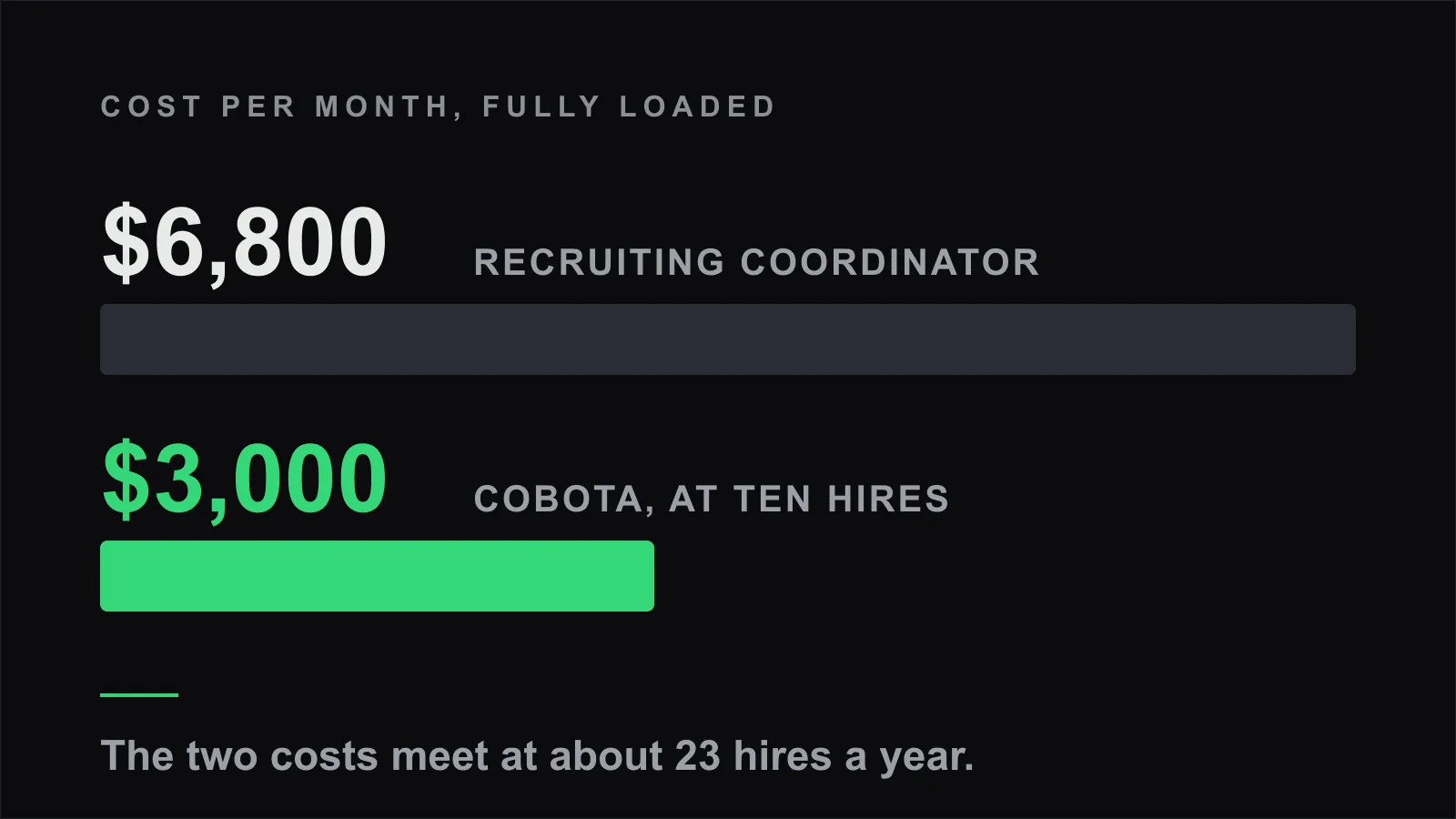
Apply that benchmark and $56,300 of base becomes roughly $82,000 a year, or about $6,800 a month. Your own figure moves with location and benefits package, and it still leaves out a laptop, software seats, and the weeks your team spends recruiting, interviewing, onboarding and training the person.
Hold that number. It is only useful next to something else.
Find the bottleneck before you price the fix
Some delays are easy to see:
- Interviews take too long to schedule.
- Candidates are waiting on updates and follow-ups.
- Interviewer feedback arrives late.
- References and paperwork sit open.
- Candidate records fall behind.
Others happen before anything reaches a calendar:
- Recruiters have no time to source enough relevant candidates.
- Outreach goes out late, or follow-up stops after one attempt.
- Interested candidates wait days for a first conversation.
- Prescreens compete with interviews and hiring manager meetings.
The first list is a coordinator's job. The second is not.
GoodTime — which sells interview-scheduling software, so read the number with that in mind — surveyed 504 senior U.S. talent acquisition leaders for its 2026 Hiring Insights Report and found talent teams spending 38% of their time scheduling interviews.
Take it at face value and it is simultaneously the best argument for a coordinator and the limit of one. Scheduling is 38%. If your roles are stalling somewhere in the other 62%, a calendar specialist will not reach it. We have made this case at more length before: the constraint is usually after candidates have been identified, not before.
Price both sides of the comparison
This is where comparisons like this one usually go quiet — ours included, until this paragraph. It is easy to cost a salary to the dollar and then describe the software alternative as "contact us for pricing."
So, plainly. COBOTA's flat plan is $300 per hire per month, billed on a minimum of ten hires: $3,000 a month at that floor, $5,400 a month at eighteen open roles. The success plan is $100 per hire per month plus $2,500 on each hire actually made. You can put your own hiring plan through the ROI calculator and see the arithmetic.
Set that against $6,800 a month for one coordinator, and the honest conclusion is that the two costs meet at around twenty-three hires a year. Below that, the software is cheaper. Above it, the coordinator is — except that you would still need someone to source, write outreach and run prescreens, because coordinating is not that job.
Which is the comparison actually worth having. Not "which is cheaper," but "which of these takes the work that is currently stuck off my team."
What COBOTA covers
COBOTA works across the connected stages rather than one of them:
- Sourcing and outreach: identifying candidates for your open roles, engaging them and following up to develop interest.
- Initial prescreening: early conversations to gather information and assess alignment with the role, with your team reviewing the results.
- Shortlisting and coordination: bringing relevant candidates forward, arranging conversations, sending reminders and keeping next steps moving.
- Follow-through: supporting feedback collection, references, background checks and offer workflows, with human review where it matters.
Your team stays where judgment is required: evaluating fit, building relationships, guiding hiring managers and making the decisions.
When the hire is still the right call
A dedicated coordinator earns the seat when your hiring runs on exceptions — complex interview panels, onsite logistics, executive scheduling, candidates who need substantial personal support.
Another recruiter earns it when what you are short of is relationship building, specialized market knowledge, hiring manager guidance or someone who can close. If your hiring plan has just doubled, we have written about that decision specifically.
In both cases COBOTA can run alongside the person, carrying sourcing, outreach, initial prescreens and routine coordination so their week goes to the work that needs their experience.
Let the work decide the investment, rather than the other way round.
Before you open the requisition
- List the bottlenecks. All of them — sourcing and outreach, not only scheduling and feedback.
- Mark where judgment matters. Decide which conversations and decisions your team should own regardless.
- Cost both options in full. Fully loaded employment cost on one side; subscription, setup, integrations and oversight time on the other.
- Test it on one live role. Track candidate engagement, prescreens completed, administrative hours, the gaps between stages and the quality of who moves forward.
You will end up with a clearer answer either way — including a much sharper description of what your next hire should own.
See how COBOTA sources, engages, prescreens and coordinates candidates on one of your open roles. Book a demo.
Sources
- Payscale, Recruiting Coordinator Salary (updated May 4, 2026): average base salary of $56,303 from 998 salary profiles. https://www.payscale.com/research/US/Job=Recruiting_Coordinator/Salary
- U.S. Bureau of Labor Statistics, Employer Costs for Employee Compensation, June 2026: for full-time private-industry workers, wages and salaries averaged $36.97 per hour and 68.5% of total compensation; benefits averaged $17.03 and 31.5%. https://www.bls.gov/news.release/ecec.nr0.htm
- GoodTime, 2026 Hiring Insights Report, a survey of 504 senior U.S. talent acquisition leaders: talent teams reported spending 38% of their time scheduling interviews. GoodTime sells interview-scheduling software. https://goodtime.io/resources/thank-you-report-hiring-insights-2026/introduction/
- COBOTA pricing as published on the ROI calculator: flat plan $300 per hire per month, success plan $100 per hire per month plus $2,500 per hire, both billed on a minimum of ten hires.